008 – Ontario election / G8 Summit / Health care / Wealth and poverty

 Comments Off on 008 – Ontario election / G8 Summit / Health care / Wealth and poverty
Jun 072007
 

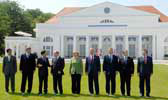
G8 Summit


We observe once again how the political landscape in Ontario offers voters little more than a choice among varying degrees of statism, as the unofficial election campaign begins with Dalton McGuinty proroguing the legislature early. Parties compete not on principles of individual freedom, but on promises to expand government control over our lives and wallets—outbidding each other on subsidies, environmental mandates, and monopolies in essential services.

We note the irony: it is often the so-called conservatives who enact the most enduring leftist policies, from income taxes to health care monopolies and rent controls. True freedom requires protecting both personal and economic rights, yet no major party advocates this consistent principle. Instead, we see pragmatists in power pursuing control for its own sake, while restricting freedoms leads inevitably to less prosperity and greater tyranny.

Globalism, properly understood, means voluntary cooperation and free trade among nations, not centralized control or anti-capitalist protests at summits like the ongoing G8. Health care remains a sacred cow of statism: a government monopoly that rations care, drives patients abroad, and bans private alternatives—unique to Ontario among Western jurisdictions. Choice and competition, not compulsion, would ensure better access and quality for all.

Finally, the perennial envy of wealth ignores how capitalism creates abundance for everyone, while socialism merely redistributes poverty. The rich deserve their earnings when gained through voluntary trade, not confiscation. In all these issues, the solution remains the recognition of individual rights and free markets—just right.

007 – John Thompson: President of The Mackenzie Institute

 Comments Off on 007 – John Thompson: President of The Mackenzie Institute
May 312007
 

John Thompson


In this edition of Just Right, we explore the stark realities of the global jihad movement with John Thompson, president of the Mackenzie Institute and a leading expert on terrorism and political extremism.

We begin by addressing Canadian attitudes toward the missions in Afghanistan and Iraq. Many Canadians view these conflicts as separate and mistaken endeavors, with polls indicating growing fatigue and a belief that continued involvement heightens vulnerability to terrorism. Yet Thompson clarifies that these are not isolated wars but manifestations of a singular worldwide phenomenon: the international jihad, encompassing Wahhabi, Salafist, Deobandist, and Khomeinist strands united by shared ideology, funding, training, and objectives.

This is no mere opinion but the jihadists’ own perspective, as they shift resources across theaters—from Iraq to Afghanistan, importing fighters from distant nations. Absent a central figure like Hitler or Stalin, the movement persists as a decades-long ideological brew, rendering quick withdrawal impossible.

We examine terrorism’s psychological underpinnings: beyond grand ideological promises of triumph, terrorists derive subconscious satisfaction from destruction and chaos. Thompson contrasts this with past Marxist terrorism, limited in lethality, against today’s far more sinister threats, including cults like Aum Shinrikyo.

In Iraq, failures stem from ignoring tribalism, debaathification errors that dismantled institutions, and external interference fueling sectarian violence. We discuss whether involvement concerns oil—Thompson asserts no, emphasizing the region’s strategic crossroads status. American imperialism proves inept at cloning democratic institutions abroad, rooted in cultural differences.

Freedom emerges as the West’s ultimate weapon against fundamentalism, though Arab elites fear its implications. Media polarization and manipulated controversies, like the Danish cartoons, divert and inflame.

Ultimately, muddling through offers the least catastrophic path, hoping moderate Muslims reclaim their faith—yet victory for jihadists would unleash unimaginable horrors.

Recognizing this global struggle for what it is remains just right.

006 – Gas prices / Afghan war / Monarchy / Environmentalism

 Comments Off on 006 – Gas prices / Afghan war / Monarchy / Environmentalism
May 242007
 

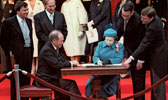
Queen signs Constitution


On this broadcast of Just Right, we addressed several pressing issues that continue to reflect fundamental principles of economics, politics, and philosophy. We began with the perennial complaints about rising gas prices, exposing the hypocrisy of politicians who decry high prices while simultaneously advocating policies to reduce consumption. As we explained, prices reflect the immutable law of supply and demand—a natural equilibrium that politicians like Liberal MP Dan McTeague and Progressive Conservative proposals foolishly seek to manipulate through increased regulation or advance notice requirements. Such interventions only lead to shortages, rationing, and further distortions of the market.

We then turned to Canada’s mission in Afghanistan, supporting Prime Minister Harper’s commitment despite public weariness fueled by media narratives. With relatively low casualties compared to everyday risks at home, we argued that abandoning the mission prematurely would constitute defeat. Negotiating with the Taliban, as suggested by some, is absurd given their ideological intransigence.

The date also prompted reflection on our constitutional monarchy. Far from irrelevant, we contended that this institution, evolved since the Magna Carta, serves as a bulwark limiting government power and preserving individual rights—a superior safeguard compared to republics that too easily devolve into unchecked statism.

Finally, we delved deeply into the environmentalist movement, reading an prescient 1969 essay by Ayn Rand that unmasks its anti-industrial, anti-human essence. Environmentalism, we demonstrated, is not about genuine pollution control (a technological issue) but about imposing collectivist dictatorship under the guise of ecological crusade. A caller’s passionate defense of balance with nature highlighted the spiritual underpinnings of this ideology, yet underscored how it often justifies coercing others.

These discussions reaffirm that true progress lies in defending individual freedom and reason against collectivist assaults. Awareness of these connections is just right.

005 – Natural Resources Stewardship Project: Global warming myths | Tom Harris

 Comments Off on 005 – Natural Resources Stewardship Project: Global warming myths | Tom Harris
May 172007
 

Tom Harris


As we reflect on our latest broadcast here at Just Right, we find ourselves once again challenging the prevailing narratives that dominate public discourse, from the so-called consensus on global warming to the insidious creep of racial quotas in municipal hiring. In our conversation, we welcomed Tom Harris from the Natural Resources Stewardship Project, whose insights underscored the complexity of climate science and the dangers of politicizing it. We delved into the notion that much of what passes for environmental urgency is not rooted in objective facts but in a self-referential system of alarmism, where dissenters are branded as deniers while evidence like solar activity influencing planetary temperatures—including the melting polar ice caps on Mars—goes unaddressed.

We also revisited our primer on the Left-Right political spectrum, emphasizing that true consistency demands accountability to principles, and we invite our listeners to hold us to that standard. Turning to local matters, we applauded City Councilor Paul Van Meerbergen for his stand against policies that prioritize skin color over merit in job applications, a practice we see as a backward step toward racism disguised as equity. Disappointingly, figures like Harold Usher dismissed these concerns, ignoring the inherent quotas that such initiatives imply. We addressed a follow-up from caller Marcel on pollution and the environment, affirming that no political faction favors environmental degradation; rather, solutions lie in technological advancement and a robust economy, not in fear-mongering.

Our discussion extended to critiques of Al Gore‘s An Inconvenient Truth, highlighting its flawed equation on technology and old ideas, and we explored how carbon dioxide—far from a pollutant—is essential to life, enhancing plant growth and oxygen production. Bans on technologies like incandescent bulbs or used oil disposal reveal a deeper agenda: government control over energy, paving the way for globalism and wealth redistribution under the guise of climate action. We proposed that conservatives convene unbiased hearings to air both sides of the debate, ensuring decisions are grounded in reason.
In wrapping up, we shared a fascinating tidbit on turtles exhibiting negligible senescence, a reminder that nature holds mysteries worth exploring. Ultimately, navigating these issues requires rejecting hysteria in favor of rational inquiry that is just right.

Note: Guest’s voice did not record on archive file, though was broadcast on-air. The silence on the audio file has been removed.

004 – Left-Right Clash Ignites Eco Fury

 Comments Off on 004 – Left-Right Clash Ignites Eco Fury
May 102007
 

Smokestacks


We find ourselves increasingly frustrated with the state of television programming, where promising shows like Drive vanish abruptly, and erratic scheduling leaves viewers disoriented. As we noted on the show, networks’ avoidance of reruns in favor of long hiatuses only exacerbates the confusion, a sentiment echoed by columnist Bill Harris. Even Lost, with its meandering plot and ratings woes, prompts us to question whether creators risk alienating audiences by shifting genres midstream—much like our anecdote about a family member rejecting Star Trek upon realizing its sci-fi essence.

We also touched on the ongoing saga of Marc Emery, whose advocacy for marijuana legalization drew thousands to Toronto, reminding us that true liberty often demands personal sacrifice against unjust laws. Turning to gas prices, we dismantled the left-wing think tank’s claims of consumer rip-offs, emphasizing that prices reflect supply and demand, not arbitrary “justifications.” Their call for regulatory regimes ignores basic economics: the market is us—producers, consumers, and retailers alike—safeguarding resources through voluntary exchange, not government fiat.

At the heart of our discussion was a reorientation of left and right ideologies, tracing back to Plato’s totalitarian mysticism versus Aristotle’s rational objectivity. We contrasted left-wing tendencies toward force, group rights, and statism with right-wing values of voluntary choice, individual justice, and freedom. This framework illuminates current debates, including a lively exchange with caller Marcel on environmental concerns. While we acknowledge pollution as a valid issue, we challenged the hysteria over CO2 and global warming, pointing out that industrialization, not its demonization, drives cleaner solutions. Caller Justin’s support reinforced our view that rationality must prevail over emotional deflection.

In the face of symbolic absurdities like bans on light bulbs and plastic bags—mere distractions from real progress—we urge a return to principled thinking. There is an enduring need for balance. Ultimately, navigating these chaos requires perspectives that are Just Right.

001 – Left and Right: An Orientation

 Comments Off on 001 – Left and Right: An Orientation
Apr 192007
 

School of Athens

Here we are with the very first broadcast of Just Right. I’m Bob Metz, stepping up to the microphone after the retirement of Jim Chapman and the end of Left, Right, and Center. I make it clear right from the start: this isn’t about being right-wing, it’s about being just right – that philosophy of freedom, reason, individual rights, voluntary choice, and tolerance that stands in stark contrast to the left’s statism, force, collectivism, whim, and intolerance, whether it comes wrapped in conservative or liberal packaging.

I lay out the real meaning of left versus right, drawing from Plato and Aristotle all the way to today’s issues like abortion (neither ban nor subsidize), Sunday shopping (treat it like any other day), and pornography (freedom of speech, not bans from the religious right or the feminist left). All Canadian parties? They’re all on the left in my book.

Then I dive into that campus controversy over the Western Gazette‘s April Fool’s spoof – a satirical piece that had the usual suspects screaming for apologies, sensitivity training, ethics codes, and even removing editors by vote. I defend it as legitimate humor and free speech, exposing the intolerance behind calls to censor “offensive” content, the myth of a “rape culture” in the West, and the feminist agenda that confuses sexuality with sexism while demanding force and funding to silence dissent. Throw in some history on pornography laws, the Fraser Committee, and the real story behind Linda Lovelace. I Even touch on a few TV shows like Drive, Lost, and that brilliant Firefly.

In the end, defending freedom of speech, individual justice, and reason against the forces of censorship and collectivism is what being on the side of freedom is all about – and that’s Just Right.

Transcript Donate