017 – Robots Rising: Sentient or Soulless?

 Comments Off on 017 – Robots Rising: Sentient or Soulless?
Aug 092007
 

Robbie the robot

Safety concerns already dominate discussions. Reports cite dozens of robot-related accidents in Britain alone, from crushings to molten aluminum spills. Japan’s guidelines demand sensors, soft materials, and emergency shut-offs, while experts debate liability when autonomous robots learn unpredictably. Isaac Asimov’s famous Three Laws of Robotics sound logical—protect humans, obey orders, preserve self—but prove riddled with unintended consequences, as Asimov himself demonstrated in his stories.

Deeper questions arise about sentience and morality. Programming right and wrong into silicon minds challenges metaphysics: can machines ever possess true choice, or do they merely execute predetermined instructions? Ethics symposiums tackle unsettling issues, from robots strong enough to crush owners to the imminent arrival of sex robots.

Local politics mirrors these themes. Debates at London City Hall over industrial development reveal a socialist resistance to market-driven growth, even when projects involve high-tech robotics. Labels like “socialist cabal” spark outrage, yet the contrast remains clear: government control versus individual management, coercion versus voluntary exchange. Socialism relies on force to achieve its ends, while true management thrives only in freedom.

Philosophy underpins it all—metaphysics, epistemology, and morality guide whether technology serves good or evil. The choice belongs solely to creators and users.

Recognizing these polarities in technology and politics proves just right.

Transcript Donate

011 – Junk Science Kills Conservatism

 Comments Off on 011 – Junk Science Kills Conservatism
Jun 282007
 

Global Warming

We delve into the pervasive clutter that fills our minds today—junk science and junk politics—drawing from recent discussions and insights that challenge the status quo. Following up on our previous guests, such as Anthony Verberkmos from Indy Media, we examine how anti-globalism and anti-war sentiments often align with the mainstream rather than true radicalism, revealing biases against America and Israel that ignore moral distinctions in conflicts. We highlight articles from the London Free Press, where Licia Corbella praises Israel as a beacon in the Middle East, and Michael Coren exposes the fault lines in blaming the West for Palestinian ills.

Turning to history, we explore how right makes might, as exemplified by the Roman Republic’s principles of representation and voluntary contributions that built its empire, contrasting with today’s moral relativism. We also address Ontario’s coal-fired plants, noting Tom Harris‘s warnings against Premier Dalton McGuinty’s closure plans, as government data shows air pollutants declining while ozone remains steady—proving coal can be clean and efficient.

The death of conservatism looms large, with columnists like Ian Urquhart and Andrew Coyne critiquing John Tory’s vague platform that mirrors liberal spending without real cuts. We recall Ayn Rand‘s 1960 obituary for conservatism, which dares not defend capitalism, the true system empowering individuals over politicians.

In our focus on junk science, we feature Terence Corcoran‘s anecdotes from Junk Science Week, debunking distorted studies and exaggerated risks. Timothy Patterson‘s research on sunspots correlates with climate cycles, showing the sun brighter now than in 8,000 years, shattering CO2 myths. Václav Klaus urges resistance to environmental hysteria that threatens freedom through global planning.

As we confront these deceptions, we advocate for objective truth in a way that is just right.

Transcript Clips & Credits Donate

006 – Gas prices / Afghan war / Monarchy / Environmentalism

 Comments Off on 006 – Gas prices / Afghan war / Monarchy / Environmentalism
May 242007
 

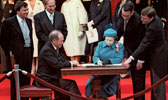
Queen signs Constitution


On this broadcast of Just Right, we addressed several pressing issues that continue to reflect fundamental principles of economics, politics, and philosophy. We began with the perennial complaints about rising gas prices, exposing the hypocrisy of politicians who decry high prices while simultaneously advocating policies to reduce consumption. As we explained, prices reflect the immutable law of supply and demand—a natural equilibrium that politicians like Liberal MP Dan McTeague and Progressive Conservative proposals foolishly seek to manipulate through increased regulation or advance notice requirements. Such interventions only lead to shortages, rationing, and further distortions of the market.

We then turned to Canada’s mission in Afghanistan, supporting Prime Minister Harper’s commitment despite public weariness fueled by media narratives. With relatively low casualties compared to everyday risks at home, we argued that abandoning the mission prematurely would constitute defeat. Negotiating with the Taliban, as suggested by some, is absurd given their ideological intransigence.

The date also prompted reflection on our constitutional monarchy. Far from irrelevant, we contended that this institution, evolved since the Magna Carta, serves as a bulwark limiting government power and preserving individual rights—a superior safeguard compared to republics that too easily devolve into unchecked statism.

Finally, we delved deeply into the environmentalist movement, reading an prescient 1969 essay by Ayn Rand that unmasks its anti-industrial, anti-human essence. Environmentalism, we demonstrated, is not about genuine pollution control (a technological issue) but about imposing collectivist dictatorship under the guise of ecological crusade. A caller’s passionate defense of balance with nature highlighted the spiritual underpinnings of this ideology, yet underscored how it often justifies coercing others.

These discussions reaffirm that true progress lies in defending individual freedom and reason against collectivist assaults. Awareness of these connections is just right.

Transcript Donate