034 – Pope vs individual salvation

 Comments Off on 034 – Pope vs individual salvation
Dec 132007
 

car air bag

Reality anchors thinking far more securely than chasing abstract truth ever could. Philosophers from Plato onward demonstrate how easily fixed doctrines detach from evidence, producing rigid positions that ignore contradictory facts. John Macmurray’s insight captures this perfectly: real thought welcomes revision as experience demands it.

Government overreach reveals similar unreality in public debates. Taser controversies fixate on the device’s “safety” rather than proper use and policy. Car regulations escalate the pattern—bans on smoking with children, mandatory seatbelts, even airbag mandates that carry hidden lethal risks in certain crashes. Statistics show airbags save lives yet also claim others, particularly when deployed improperly. Mandating such devices overrides personal choice under the guise of protection.

Pope Benedict’s encyclical challenges modern Christianity’s emphasis on individual salvation, contrasting it with earlier communal approaches. This critique echoes collectivist themes that downplay independent reason. Hope, too, comes under scrutiny—when it substitutes for action, it paralyzes rather than empowers.

Japan’s robotics surge offers a forward-looking contrast, with Toyota and Honda developing humanoid machines for everyday assistance. These innovations highlight economic and technological shifts worth watching closely.

Exploring these intersections of philosophy, policy, and progress proves consistently illuminating and just right.


Transcript Donate

29 – Marc Emery: Martyr to Madness?

 Comments Off on 29 – Marc Emery: Martyr to Madness?
Nov 012007
 

Marc Emery

Marc Emery’s impending extradition to the United States for selling marijuana seeds raises profound questions about sovereignty, justice, and the irrationality of drug prohibition laws. In this episode of Just Right, the discussion centers on Emery’s lifelong activism, tracing his path from a London bookseller to a political firebrand challenging censorship, taxes, and government overreach.

Emery emerges as a complex figure—abrasive yet principled, self-promoting like Muhammad Ali, but driven by a passion for individual freedom. His early debates with the host at City Lights Bookshop sparked shared ventures, including publishing newspapers like The London Tribune and The London Metro Bulletin, and co-founding the Freedom Party of Ontario in 1984. Campaigns against the 1991 Pan Am Games bid saved London taxpayers millions, while fights against Sunday shopping laws and business improvement areas demonstrated how civil disobedience can triumph over bureaucratic folly.

Clips from films like Mr. Smith Goes to Washington and documentaries such as Prince of Pot: The U.S. vs. Marc Emery illustrate Emery’s influences and current plight, where U.S. authorities target him not just for seeds, but for funding legalization efforts—a clear political vendetta. Speakers in these excerpts, including Emery himself comparing his struggle to Martin Luther King and Nelson Mandela, highlight the absurdity of facing life imprisonment in America for acts that warrant mere fines in Canada. Note that these views do not necessarily reflect those of the host or Just Right.

The episode underscores broader implications: if Canada extradites Emery, it surrenders sovereignty to insane U.S. drug policies, setting a dangerous precedent for any activist. Differences between Emery’s anarchistic leanings and the host’s perspectives add nuance, yet unity persists on core principles of liberty.

In examining Emery’s story, the pursuit of justice demands vigilance against such moral obscenities, ensuring freedoms remain just right for all.

Transcript Donate

026 – Ontario election 2007

 Comments Off on 026 – Ontario election 2007
Oct 112007
 

Stress

The recent Ontario election delivers no shocks, with Liberals securing another majority amid record-low voter turnout. Faith-based funding emerges as the flashpoint, revealing deep divides: Liberals cling to a state monopoly that forces double payments on parents opting for private schools, while Conservatives peddle taxpayer-funded “choice” that contradicts true freedom. This debate echoes Ontario’s tangled history, where education roots in political control—from Simcoe’s 1791 fears of republican heresy to the 1807 District Public School Act subsidizing wages, and Strachan’s 1816 Common School Act demanding allegiance to the crown. Reformers and Tories battled over funding from clergy reserves, all aiming to suppress “Yankee” ideas and instill moral training from the Scriptures.

Public education’s monopoly prioritizes indoctrination over learning, as Khalil Ramal admits—it’s about “integrating” society into one vision. Shared values like freedom to disagree must unite us, yet the system stifles innovation, rewards union seniority over merit, and inflates costs even as enrollment drops. Complaints from the 1980s ring true today: political masters ignore classrooms, curricula bow to pressure not preferences, and diplomas lose meaning amid literacy gaps.

Michael Coren’s cynical Thanksgiving rant captures broader discontent—Canada as a “home on native land” plagued by unresolved claims, eroding freedoms via Human Rights Commissions, lenient justice for criminals, a flawed Charter empowering radicals, and a health care system ranked 30th globally. Abroad, respect fades as our warrior heritage withers under emasculation.

Federally, Harper’s drug war escalation promises mandatory sentences and millions for enforcement, prevention, and treatment, yet ignores failed prohibition’s lessons. Criminalizing substances empowers gangs, inflates profits tax-free, and confuses addiction with restraint of trade. Better to legalize, end welfare for abusers, and hold individuals accountable for actions, not possessions.

Workplace stress hits hardest in repetitive jobs, while Canada Post’s antiquated monopoly exemplifies government inefficiency—outdated machines, accidents galore, and static delivery amid urban growth.
In this landscape of monopolies and misplaced priorities, finding balance remains just right for true progress.

Transcript Donate

024 – God: All About Nothing?

 Comments Off on 024 – God: All About Nothing?
Sep 272007
 

God

In our exploration of faith and reality, questions arise that challenge the very foundations of belief: Is God a literal creator or a symbolic representation of existence itself? Society clings to notions of divinity that influence everything from politics to personal choices, with statistics revealing how North Americans envision God as authoritarian, benevolent, critical, or distant—shaping views on issues like abortion, wealth distribution, and even war.

These conceptions often blur the line between mysticism and reason, prompting a deeper look at creation myths versus the axiom that existence simply exists, without beginnings or ends. Concepts like nothingness prove illusory, as even zero in mathematics serves as a placeholder, not an absence of reality. Religion, in its essence, promotes self-restraint and discipline, yet literal interpretations can lead to conflicts with knowledge and free thought.

Morality emerges not from divine decree but from human choice and awareness, navigating the debate between determinism—where every action seems predestined—and free will, which affirms our power to shape destinies. Historical ties between religion and state power, from ancient councils to modern policies, underscore how faith becomes a tool for control.

Politics and religion intertwine inescapably, raising provocative inquiries: Can true freedom of religion exist without freedom from it? Listeners tuning in discover perspectives that provoke thought and challenge assumptions, where understanding these dynamics keeps society balanced in a way that is just right.

Transcript Donate

023 – State Funding Kills Religious Education

 Comments Off on 023 – State Funding Kills Religious Education
Sep 202007
 

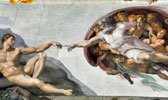
God and Adam

The controversial proposal to extend tax funding to faith-based schools dominates Ontario’s 2007 provincial election, yet the real issue escapes most observers. Both John Tory’s plan to integrate religious schools into the public system and Dalton McGuinty’s opposition mask the same danger: expanded government control over what children learn.

Tax dollars always come with strings. Once religious schools accept public funding, courts and bureaucrats dictate curriculum and policies, overriding faith-based distinctions. The Marc Hall case proves this principle— a Catholic board’s refusal to allow a same-sex prom date collapsed under Charter equality provisions, despite religious objections. He who pays the piper calls the tune.

Public education already suffers under this monopoly. Literacy rates decline, standards soften, and moral relativism replaces objective values. Extending funding merely grows the beast without addressing its failures. Creationism debates distract from the core problem: forcing taxpayers to subsidize others’ education choices while surrendering parental authority to the state.

True diversity demands separation of school and state. Parents must reclaim responsibility for their children’s education, free from coercive funding that homogenizes beliefs under the guise of inclusion. Only then can genuine freedom in education emerge—one that respects individual rights and rejects forced assimilation. That’s the perspective just right for preserving both faith and liberty.

Transcript Donate

022 – Afghanistan: A sense of the place | Arthur Majoor

 Comments Off on 022 – Afghanistan: A sense of the place | Arthur Majoor
Sep 132007
 

Arthur Majoor

In the shadow of the sixth anniversary of 9/11, our discussion turns to Canada’s unexpected role in Afghanistan, a mission that defies the media’s narrow focus on combat. Joined by Sergeant Arthur Majoor, fresh from a six-month tour in Kandahar, the conversation reveals a landscape far removed from the alien desolation often portrayed. Mountains loom against a red desert, temperatures soar to the low 50s, yet adaptation becomes second nature amid air-conditioned bases and limited outdoor exertion.

The media’s obsession with battles obscures the true essence of our efforts: a seamless blend of security and reconstruction. Provincial Reconstruction Teams, bolstered by battle groups, enable projects that rebuild infrastructure without immediate Taliban sabotage. Afghanistan’s history unfolds as a tale of instability—from constitutional monarchy disrupted by 1970s droughts and factionalism, to Soviet invasion in 1979, Mujahideen resistance, civil wars, and Taliban tyranny that froze society under draconian rule. Ejected in 2001, the Taliban left a void now filled by ISAF’s multinational alliance of 38 nations, including Canada, committed through the UN-mandated Afghan Compact until 2011.

Progress manifests in small but profound ways: reclaiming irrigation ditches, building village schools and clinics, fostering community councils—including those for women—and training Afghan National Army battalions. Yet challenges persist, with 30 years of educational voids hindering skilled labor like engineers or mechanics. Canada’s $1.2 billion aid over a decade supports this, spurring local economies rather than flooding with foreign goods. Critics who demand withdrawal ignore the symbiotic tie between combat and development; pulling out prematurely risks undoing gains in a geopolitically volatile region bordering nuclear powers.

Humanitarianism aligns with our self-image as UN supporters and human rights advocates, countering Taliban ferocity against education and freedom. Villagers actively aid ISAF, exposing caches and informing on threats, proving local rejection of fear-based rule. As Canadians historically tackle immense challenges—from building the CPR to forging NATO—staying the course honors our values. In this pivotal endeavor, success demands persistence that hits just right.

Transcript Clips & Credits Donate

020 – Health care? / Hitler was a socialist

 Comments Off on 020 – Health care? / Hitler was a socialist
Aug 302007
 

Machine that goes Bing! 

Continuing our critique of Canada’s socialized health care system, we feature compelling insights from Dr. Tom Dorman, a physician who fled both the British and Canadian systems. Dorman rightly defines true insurance as voluntary asset protection against catastrophe—not the compulsory, taxpayer-funded scheme masquerading as “health insurance” today. Mandatory coverage, he argues, reduces patients to mere chattels, valued only until treatment becomes uneconomical, much like cattle on a farm.

The incoming CMA president, Brian Day, claims to inject “market principles” into the public system while insisting full privatization is impossible. This contradiction exposes a deeper flaw: genuine markets thrive on voluntary exchange, not coerced taxation. Day’s approach merely rearranges the deck chairs on a sinking collectivist ship.

Shifting to another form of taxpayer plunder, arts organizations lobby politicians for forced funding, equating their subsidies to health care entitlements. John Tory enthusiastically obliges, promising multi-year commitments and councils to “nourish” culture. Yet culture flourishes through voluntary support, not government coercion. The Freedom Party correctly condemns this as morally repugnant—theft disguised as benevolence.

Finally, we examine Nazism’s collectivist roots. Adolf Hitler’s regime built a popular welfare state financed by plundering Jews and conquered nations. The National Socialist German Workers’ Party delivered “benefits” through altruism and sacrifice for the collective—principles echoing modern statism. Hitler’s vaunted Aryan superiority rested not on intellect or strength, but on willingness to self-sacrifice for the community.

Recognizing collectivism’s destructive patterns in health care, arts funding, and historical tyranny offers the perspective that is just right.

Transcript Donate